
New Year, New Standards
What are the Resuscitation Council 2025 guidelines and how were they developed?
Every five years, the International Liaison Committee on Resuscitation (ILCOR), the European Resuscitation Council (ERC), and the Resuscitation Council UK (RCUK) publish updated guidelines for resuscitation. These updates are based on the latest scientific evidence, best clinical practice, and patient outcomes, aligning closely with the National Institute for Health and Care Excellence (NICE). Their goal is to continually improve survival rates and the quality of life for those experiencing medical emergencies.
What do we already know?
Out-of-Hospital Cardiac Arrest (OHCA)
Each year, approximately 115,000 out-of-hospital cardiac arrests (OHCAs) are reported to UK ambulance services.
Resuscitation is attempted in around 43,000 cases.
Most occur at home, and the majority involve men over 65 with underlying cardiac conditions.
Bystander CPR is attempted in 60–73% of cases, but AEDs are used in fewer than 10%.
Shockable rhythms occur in 15–22% of cases.
Return of Spontaneous Circulation (ROSC) is achieved in roughly a quarter of patients, with 9–10% surviving beyond 30 days.
However, when bystanders are trained and act promptly, ROSC increases to 50–57%, and 30-day survival rises to 30%.
Outcomes are notably poorer in deprived, urban, and ethnically diverse communities, highlighting the importance of universal access to training and equipment.
If someone collapses suddenly, cardiac arrest should always be suspected until proven otherwise.
Out of hospital Paediatric cardiac arrest remains rare (around 750–800 cases annually), but early recognition and intervention are just as vital.
What are the key changes and updates within the 2025 guidelines?
Firstly, First Aid!
Hooray! For the first time, there is a whole new chapter dedicated to first aid, and the vital role first aiders play in the chain of survival
Supporting first aiders to undertake a structured assessment approach in emergencies.
ABCDE stands for A-Airway, B-Breathing, C-Circulation, D-Disability, E-Exposure. Using this format will enable first aiders to identify and treat problems in a logical order. We have an introductory video on this structure coming soon, and we will be expanding training of this on all our first aid course, so you feel more equipped on looking after your casualty until more help arrives.
Higher priority of life threatening bleeding:
Life threatening bleeding should be initially treated with direct pressure over the wound. If ineffective, then an escalating approach should be followed using tourniquets and/or haemostatic dressings. This will be taught more routinely on all first aid courses.
Amputated parts should be wrapped damp, sealed & placed on (not in) ice
Hypoglycaemia (low blood sugar) is recognised not just to occur in people with diabetes.
Children may take ½ tsp sugar under tongue if responsive.
Anaphylaxis
If two autoinjectors used, the new guidelines have made it clearer that the second auto adrenaline injector should be administered in the opposite thigh.
Adult CPR & Basic Life Support
Suspect cardiac arrest in people found unconscious. Call 999 immediately, and if untrained, the call handler will be able to talk you through checking for normal versus abnormal or absent breathing.
Panting or panting like breathing movements are now recognised additional signs of abnormal breathing, particularly in athletes. These signs should not be misinterpreted as normal breathing.
Give chest compressions at a rate of 100–120 per min at depth of 5-6cm
Add rescue breaths if trained, willing and or able to do so. Give 2 breaths after every 30 compressions (30:2)
If untrained, or unwilling or unable, deliver chest compression only CPR.
CPR on a bed and over the head
If moving someone from the bed to the floor when starting CPR delays intervention, remove the pillows, and kneel beside them
Do not move them to the floor
If in a confined or small space, chest compression can be delivered over the person’s head
AED use and revised pad placement
In adults, place the AED pads in the position shown below. This position can also be utilised for children/adolescents over 25kg (Approximately 8 years of age).
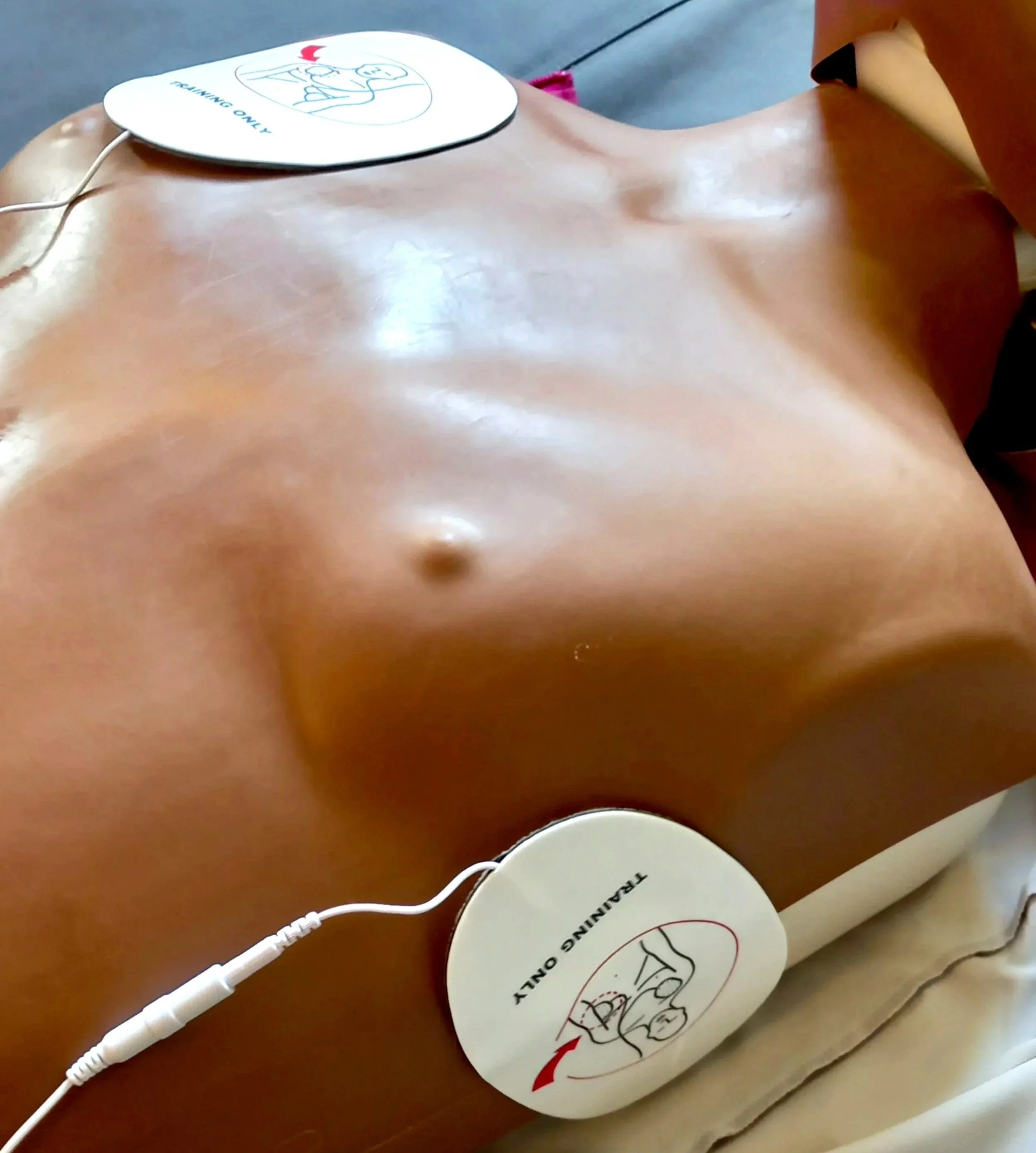
Place one pad on the right hand side of the chest, just below the right collar bone, and the second pad on the left hand side of the chest just below the armpit
Rationale: This revised pad placement aims to optimise the electrical current across the heart, ultimately aiming to improve survival rates.
Paediatric CPR & Basic Life Support
Revised paediatric CPR sequence:
(Applies to trained responders, and those with professional responsibility for babies, children and adolescents):
Start with 5 rescue breaths first (ventilations should only be enough to rise the chest)
Followed by ratios of 15 compressions to 2 breaths (A ratio of 30 compressions to 2 breaths can still be used for those not specifically trained in paediatric basic life support). Aim for a compression depth of a third of the depth of the chest. In adolescents (13-18year olds), aim for a compression depth of 5-6 cm.Cardiac arrest in children is primarily due to respiratory failure rather than cardiac cause, so oxygen restoration is critical.
Compressions should be given at a third of the depth of the chest at a rate of 100-120 compressions a minute
Infant (Under 1’s) CPR and Basic Life Support
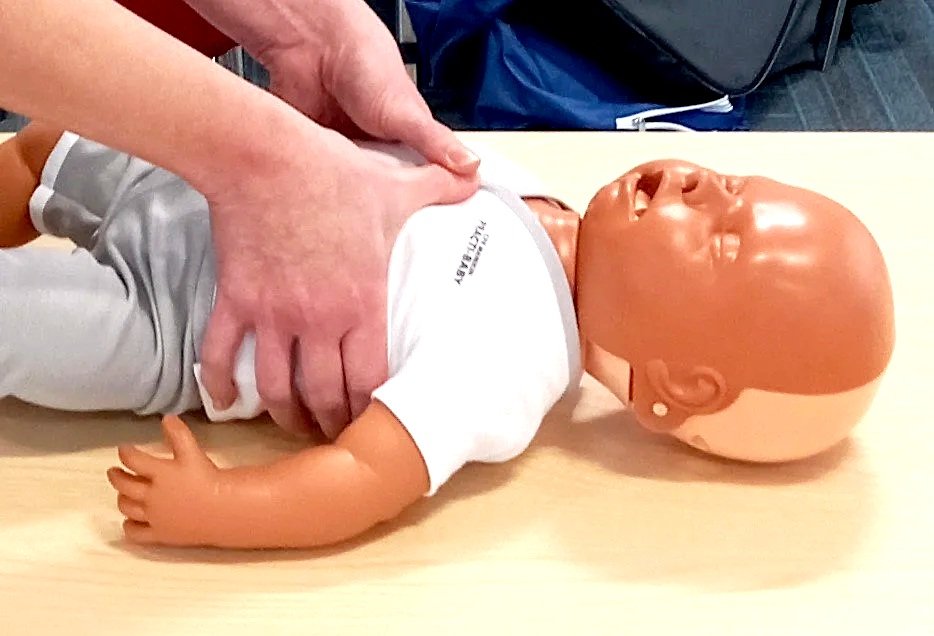
Revised infant CPR technique uses thumb-encircling method, replacing two-finger compressions.
Choking in Infants (Under 1’s)
The two thumb encircling technique is now also used for chest thrusts in choking. Watch our new video below to find out more.
AED use and revised paediatric pad placement
Reminder that AEDs can be used in all ages.
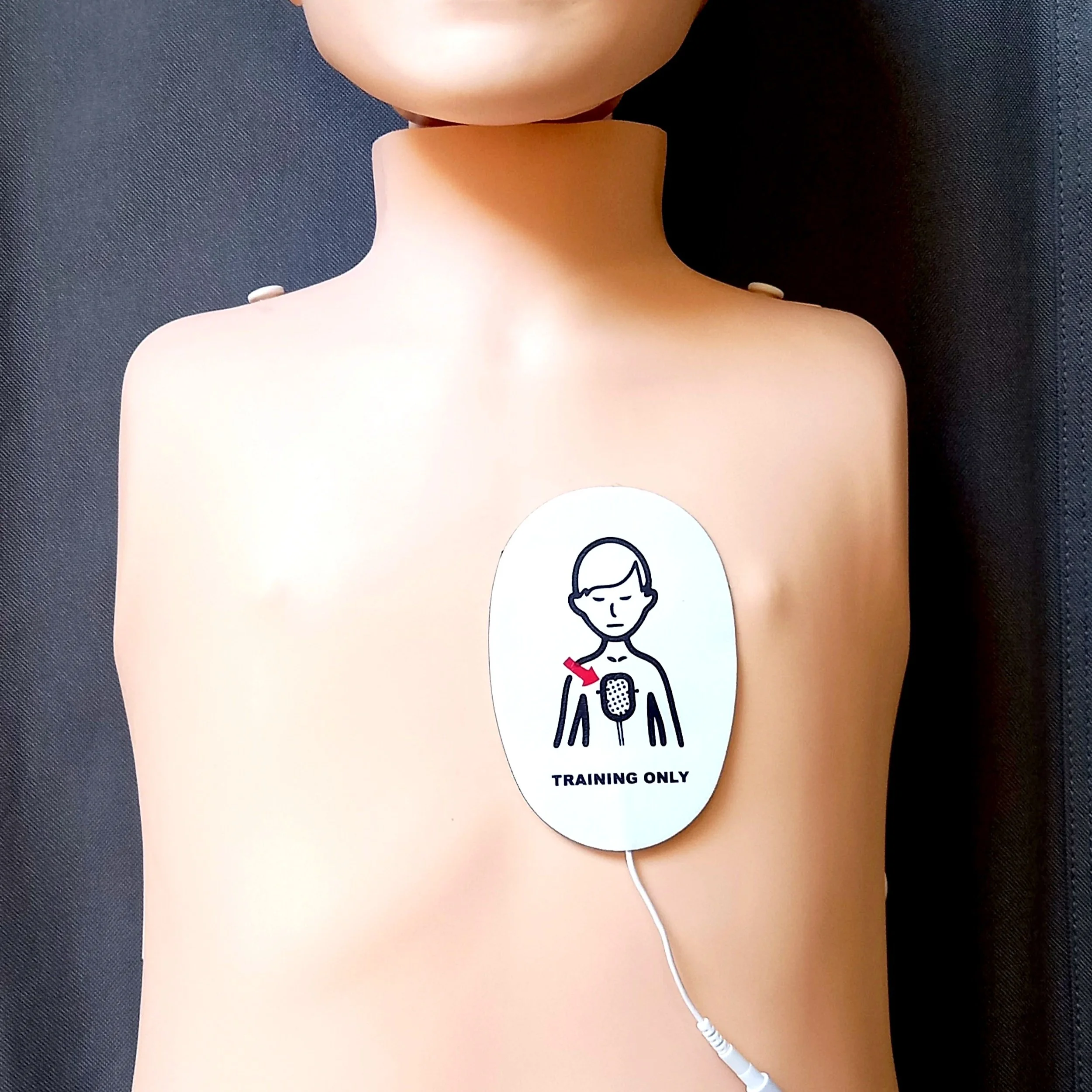
In children, place the pads on the front and back of the child. The front pad should be placed in the centre of the chest, just to the left of the sternum.
Remember our training values - Doing something is always better than doing nothing
How will the new changes impact your first aid and CPR training with us?
This new guidance will become the standard on first aid and CPR courses from January 2026.
We will start introducing the key changes to our courses from this point, and our quality and compliance partner are working hard to update all training materials.
Our commitments to you
We will continue to champion the learning of CPR and life saving skills and teach you to the latest guidance.
We will continue to tailor courses to your needs and support you to develop confident assessment and treatment skills across a range of injuries and illnesses.
Our courses will remain taught by clinical experts with a warm, friendly, and informative outlook. Our courses are open to all.
Contact us to book your place on one of upcoming courses in Bury St. Edmunds, or to arrange in house training for your business, workplace club or community group.
Anglia CPR - For Professionals, For Workplaces, For the Community.